Understanding Intelligence Through Computation
Research in the Mante lab aims to uncover how complex cognitive abilities, such as reasoning, problem-solving, and decision-making, emerge from the coordinated activity of neural populations distributed across brain-wide networks. We take an interdisciplinary approach that integrates behavioral and neurophysiological experiments in humans and monkeys with computational methods, including machine learning for analyzing large-scale behavioral and neural datasets and artificial intelligence for modeling these datasets and generating hypotheses about the neural computations underlying cognition. Beyond studying cognition in neurotypical humans and monkeys, we seek to understand how disruptions in these neural computations contribute to cognitive deficits in neurological and psychiatric disorders. In parallel, we develop novel analytical approaches for high-dimensional datasets, advancing data science in neuroscience and related fields.
Inferring Structure in High-Dimensional Data
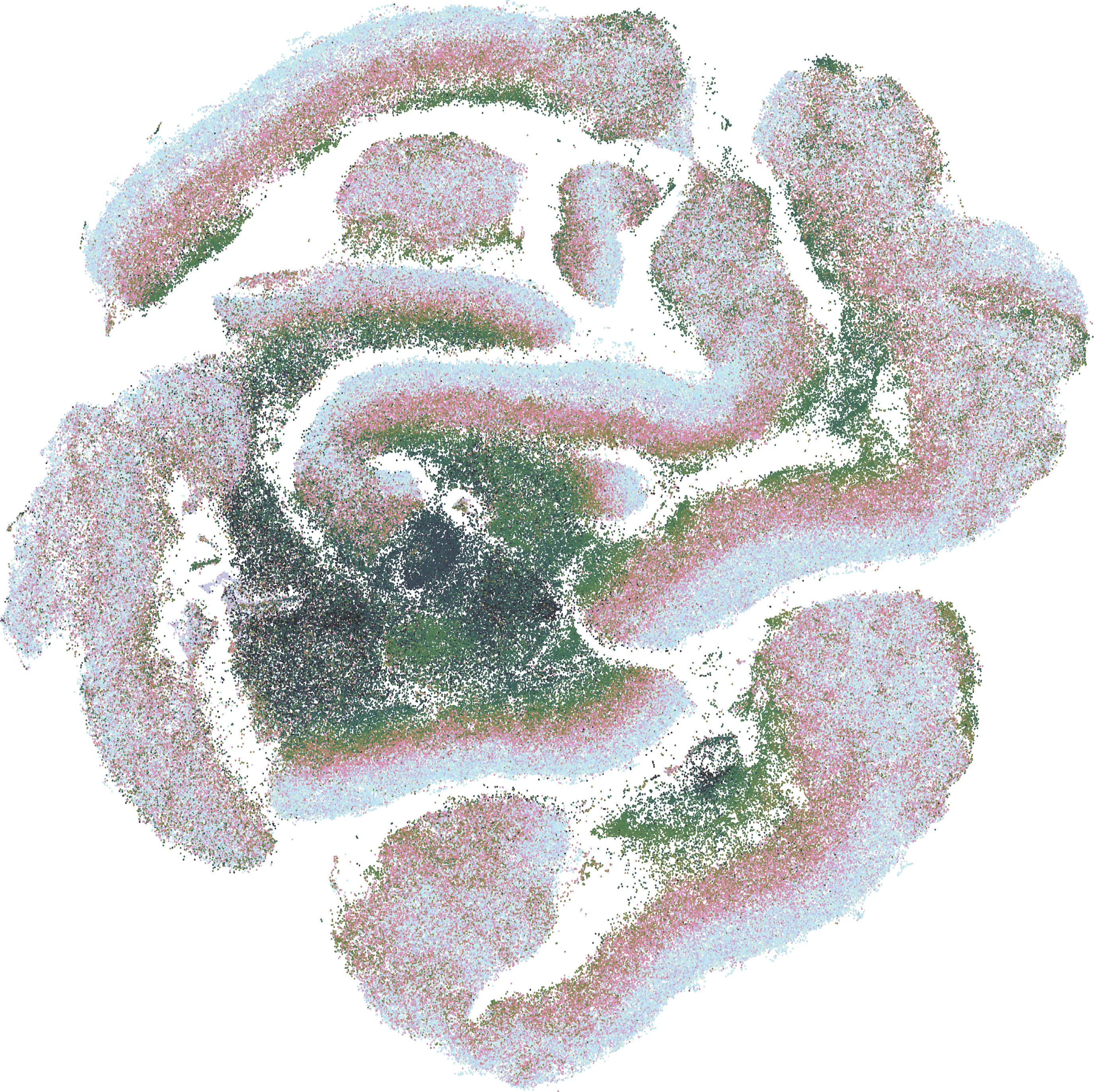
Advances in experimental methodologies in neuroscience lead to ever-larger behavioral and neural data sets. Such data is highly structured, but describing this structure quantitatively is typically very challenging. Most often we lack good models of natural behavior or neural computations that could point to the most relevant aspects of the data. One focus of the lab is to develop generally applicable methods that can reveal the structure in large datasets without strong assumptions about the properties of the underlying data. We recently introduced non-parametric approaches based on nearest-neighbor statistics to reveal the topology of dense, high-dimensional data. These approaches make only weak assumptions about the nature of the data (e.g. clustering) and are thus broadly applicable. Together with more traditional Targeted Dimensionality Reduction techniques, these methods can provide quantitative, unbiased descriptions of the structure of high-dimensional behavioral and neural data.
Behavioral Mechanisms of Cognition
Decision-making paradigms are used in basic and clinical research to reveal the processes underlying normal and impaired cognition. Mechanistic models of behavior play a key role in interpreting the choices of participants in these tasks. For one, they can reveal how perceptual processes interact with cognitive processes like attention, impulsivity, or biases to form a choice. For another, they provide access to latent variables (like the momentary belief or confidence of the participant) that may be more tightly linked to the underlying neural processes than the observed choices. We combine approaches from Bayesian inference, stochastic differential models, and a lot of computational power to evaluate hundreds of models on the behavior of individual participants (humans or macaques). This approach leads to a fine-grained characterization of the latent decision processes in each individual, but also reveal considerable differences across individuals. The resulting quantitative descriptions of behavior form the basis of analyses of concurrently measured neural activity and could provide new insights into the nature of cognitive deficits in psychiatric and neurological disorders.
Neural Mechanisms of Cognition
Our past work lends support to the hypothesis of "computation-through-dynamics", the idea that computations in the brain emerge from and are best understood at the level of collective dynamics of large neural populations. We characterize and model neural population dynamics with a variety of tools, including decoding approaches, fits of linear and non-linear dynamical systems, and deep neural networks trained both with supervised and unsupervised (reinforcement-learning) methods. Reverse-engineering of the trained networks provides novel hypotheses about the nature of neural computations in the brain. We focus predominantly on understanding computations underlying cognitive abilities like long-term planning, inhibitory control, and attention. These abilities are thought to rely critically on a network of areas in prefrontal cortex. The great majority of these areas exist only in primates, which is why we study macaques. Ultimately our models of computations should be precise enough to predict the neural and behavioral consequences of arbitrary causal perturbations of the population activity, and explain the mechanism underlying cognitive deficits akin to those observed in psychiatric disorders.

Selected Publications
-
Context-dependent computation by recurrent dynamics in prefrontal cortex Nature, 503(7474), 78--84, 2013
-
Set in one's thoughts Nature Neuroscience, 21(4), 459--460, 2018
-
Operative dimensions in unconstrained connectivity of recurrent neural networks Conference on neural information processing systems (NeurIPS22), 2022
-
Residual dynamics resolves recurrent contributions to neural computation Nature Neuroscience, 326--338, 2023
-
Are task representations gated in macaque prefrontal cortex? arXiv, 2023
-
Inferring context-dependent computations through linear approximations of prefrontal cortex dynamics Science Advances, 2024
-
Individual variability of neural computations underlying flexible decisions Nature, 421--429, 2024
-
Population-level coding of avoidance learning in medial prefrontal cortex Nature Neuroscience, 27, 1805--1815, 2024
-
Prospective and retrospective representations of saccadic movements in primate prefrontal cortex Cell Reports, 115289, 2025
-
Mechanistic Interpretability of RNNs emulating Hidden Markov Models ArXiv, 2025
Structure and Dynamics of Natural Behavior
While our models of neural computation are mostly based on neural activity recorded in laboratory settings, they should ultimately also explain brain function during rich natural behaviors. To establish this link, we aim to record neural activity in the same animals both in the laboratory and in natural settings. Quantifying and understanding natural behaviors, however, is a challenge on its own. To tackle this challenge, we develop both non-parametric and model-based approaches to infer the structure and dynamics in dense, high-dimensional behavioral data. In one line of research we study how the developing song a of juvenile bird changes over the course of many months of training. Song development is a powerful model of motor learning during a complex, natural behavior, which can conveniently be recorded with just a microphone. In another line of research, we use continuous video recordings to study individual and social behaviors in a group of monkeys living in a zoo-like enclosure. Extracting the relevant behavior from videos is hard, and requires state-of-the art approaches from computer vision and machine-learning.
Code & Data
All the data and code below are made available under the GPL3 license, unless specified otherwise under the corresponding link. Please cite the relevant publication(s) if you use any of the data or code in a manuscript.
Neural recordings and code from Mante et al, Nature 2013
This dataset includes neural recordings from FEF and pre-arcuate cortex in macaque monkeys and Matlab code to perform Targeted Dimensionality Reduction on the recordings.
-
Context-dependent computation by recurrent dynamics in prefrontal cortex. Nature 503, 78--84, 2013.
Code from Kollmorgen et al, Nature 2020
The Matlab code below implements the nearest-neighbour-based analyses in Kollmorgen et al (repertoire dating).
-
Nearest neighbours reveal fast and slow components of motor learning. Nature 577, 526--530, 2020. DOI: 10.1038/s41586-019-1892-x.
Neural recordings from Calangiu et al, Cell Reports 2025
This dataset includes Utah-array recordings from prefrontal cortex of macaque monkeys engaged in a variety of behavioral tasks (instructed saccades, perceptual decisions, value-based decisions).
-
Prospective and retrospective representations of saccadic movements in primate prefrontal cortex. Cell Reports, 44 (2), 2025.